Philosophy, from the Presocratics to today
Over 130 thinkers: Presocratics, Athens, Hellenistic schools, the Middle Ages, the Enlightenment, German idealism, existentialism, analytic philosophy, the Frankfurt School, French thought and Asian thought.
Science, ideas and tech · 135 characters and places · 192 relationships
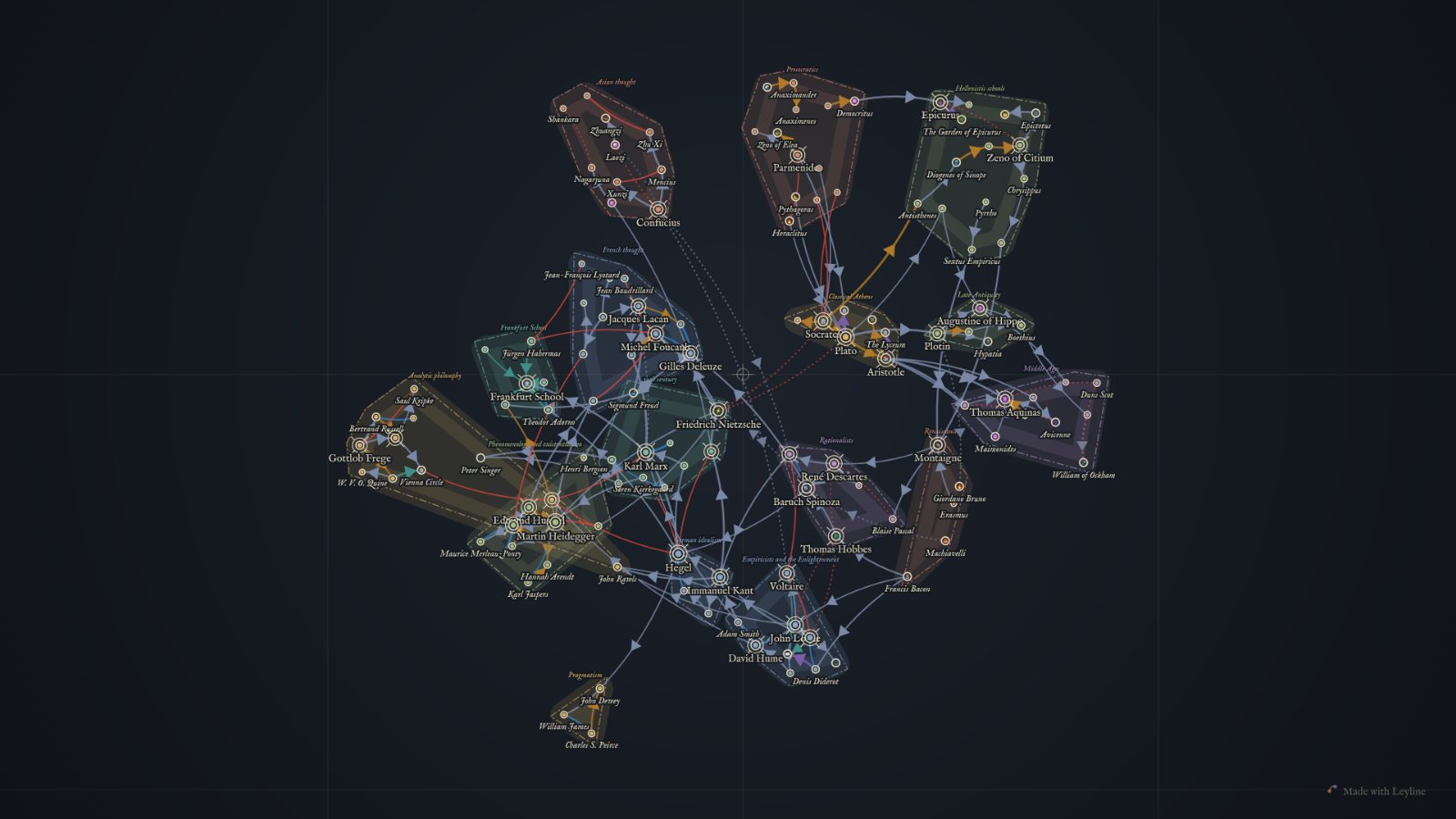
Open and edit this mapFree, no account needed. The map becomes yours: add what you know.
Groups
Presocratics
- 🌊 Thales · All is water: the first to seek a natural principle behind everything.
- Anaximander · The apeiron, the boundless.
- Anaximenes · Air as the first principle.
- 📐 Pythagoras · Number as the first principle; a religious and mathematical community.
- 🔥 Heraclitus · Everything flows; the unity of opposites.
- Parmenides · What is, is; what is not, is not.
- 🐢 Zeno of Elea · Paradoxes of Achilles and the tortoise.
- Empedocles · The four elements, Love and Strife.
- Anaxagoras · Nous, the ordering mind.
- Leucippus · Inventor of atomism.
- ⚛️ Democritus · Atoms and the void.
- Protagoras · Sophist: man is the measure of all things.
- Gorgias · Sophist and rhetorician.
Classical Athens
- 🏛️ Socrates · Wrote nothing; sentenced to drink hemlock in 399 BC.
- Plato · The Forms, the Republic, the Socratic dialogues.
- 🏛️ The Academy · School founded by Plato in Athens.
- 📚 Aristotle · Logic, physics, ethics, politics: encyclopedic knowledge.
- 🏛️ The Lyceum · The Peripatetic school founded by Aristotle.
- ⚔️ Alexander the Great
- Xenophon · Disciple of Socrates, historian.
Hellenistic schools
- Antisthenes · Disciple of Socrates, forerunner of Cynicism.
- 🛢️ Diogenes of Sinope · The Cynic in his barrel.
- Crates of Thebes · Cynic, Zeno's teacher.
- Zeno of Citium · Founder of Stoicism, under the Porch (stoa).
- Chrysippus · Second founder of Stoicism.
- 🍇 Epicurus · Pleasure as freedom from disturbance.
- 🌿 The Garden of Epicurus · Epicurus's school in Athens.
- Lucretius · On the Nature of Things.
- Pyrrho · Founder of skepticism.
- Sextus Empiricus · Outlines of Pyrrhonism.
- Cicero · Brings Greek philosophy to Rome.
- Seneca · Stoic, Nero's tutor.
- ⛓️ Epictetus · Freed slave, Stoic: what is up to us.
- 👑 Marcus Aurelius · Stoic emperor, the Meditations.
Late Antiquity
- Plotin · Founder of Neoplatonism: the One.
- Porphyry · Plotinus's disciple and editor.
- 🔭 Hypatia · Mathematician and philosopher of Alexandria.
- ✝️ Augustine of Hippo · The Confessions, The City of God.
- Boethius · The Consolation of Philosophy.
Middle Ages
- Al-Farabi · The “second teacher” after Aristotle.
- ⚕️ Avicenne · Ibn Sīnā, Persian philosopher and physician.
- Averroes · Ibn Rushd, Aristotle's “Commentator”.
- ✡️ Maimonides · The Guide for the Perplexed.
- Anselm of Canterbury · Ontological argument for the existence of God.
- Peter Abelard · The problem of universals; Héloïse.
- Albertus Magnus · Dominican, Thomas's teacher.
- ✝️ Thomas Aquinas · Summa Theologica: Aristotle and Christian faith.
- Duns Scot · The “Subtle Doctor”.
- 🪒 William of Ockham · Ockham's razor, nominalism.
Renaissance
- Erasmus · In Praise of Folly, humanism.
- 🦊 Machiavelli · The Prince.
- ✒️ Montaigne · The Essays: “What do I know?”
- 🔥 Giordano Bruno · An infinite universe; burned in Rome in 1600.
- 🔬 Francis Bacon · Novum Organum, the experimental method.
Rationalists
- René Descartes · I think, therefore I am.
- 🐉 Thomas Hobbes · Leviathan.
- Blaise Pascal · The Pensées, the wager.
- 🔍 Baruch Spinoza · The Ethics: God or Nature.
- Nicolas Malebranche · Occasionalism.
- Leibniz · Monads, the best of all possible worlds.
Empiricists and the Enlightenment
- John Locke · Empiricism, political liberalism.
- George Berkeley · To be is to be perceived.
- David Hume · A Treatise of Human Nature, skepticism about causation.
- ⚖️ Montesquieu · The Spirit of the Laws, separation of powers.
- Voltaire · Candide, tolerance.
- Denis Diderot · Edits the Encyclopédie.
- 📖 The Encyclopédie · The Enlightenment's summa, edited by Diderot and d'Alembert.
- Jean-Jacques Rousseau · The Social Contract, Emile.
- Adam Smith · The Wealth of Nations.
German idealism
- Immanuel Kant · Critique of Pure Reason.
- Fichte · The Science of Knowledge.
- Schelling · Philosophy of nature.
- Hegel · Phenomenology of Spirit, dialectics.
19th century
- Arthur Schopenhauer · The World as Will and Representation.
- Søren Kierkegaard · Either/Or, father of existentialism.
- Ludwig Feuerbach · The Essence of Christianity.
- Karl Marx · Capital, historical materialism.
- Friedrich Engels · Co-author of the Manifesto.
- Jeremy Bentham · Founder of utilitarianism.
- John Stuart Mill · On Liberty, Utilitarianism.
- Auguste Comte · Founder of positivism.
- ⚡ Friedrich Nietzsche · God is dead; the will to power.
- 🛋️ Sigmund Freud · Inventor of psychoanalysis.
Pragmatism
- Charles S. Peirce · Founder of pragmatism.
- William James · Pragmatism and psychology.
- John Dewey · Pragmatism, philosophy of education.
Phenomenology and existentialism
- Edmund Husserl · Founder of phenomenology.
- Martin Heidegger · Being and Time.
- Karl Jaspers · German existentialism.
- Jean-Paul Sartre · Being and Nothingness.
- Simone de Beauvoir · The Second Sex.
- Maurice Merleau-Ponty · Phenomenology of Perception.
- Albert Camus · The Myth of Sisyphus, the absurd.
- Emmanuel Levinas · Totality and Infinity, the face of the Other.
- Hannah Arendt · The Origins of Totalitarianism.
- Henri Bergson · Creative Evolution, duration.
Analytic philosophy
- Gottlob Frege · Father of modern logic.
- Bertrand Russell · Principia Mathematica.
- G. E. Moore · Principia Ethica, common sense.
- Ludwig Wittgenstein · Tractatus, then Philosophical Investigations.
- 🏛️ Vienna Circle · Logical empiricism.
- Rudolf Carnap · Leading figure of the Vienna Circle.
- Karl Popper · Falsifiability, The Open Society.
- W. V. O. Quine · Two Dogmas of Empiricism.
- John Rawls · A Theory of Justice.
- Saul Kripke · Naming and Necessity.
- 🐾 Peter Singer · Animal Liberation.
Frankfurt School
- 🏛️ Frankfurt School · Institute for Social Research, critical theory.
- Max Horkheimer · Director of the Institute.
- Theodor Adorno · Dialectic of Enlightenment, Minima Moralia.
- Herbert Marcuse · One-Dimensional Man.
- Walter Benjamin · The Work of Art in the Age of Mechanical Reproduction.
- Jürgen Habermas · The Theory of Communicative Action.
French thought
- Ferdinand de Saussure · Course in General Linguistics.
- Claude Lévi-Strauss · Structural Anthropology.
- Jacques Lacan · Psychoanalysis: the return to Freud.
- Louis Althusser · For Marx, ideological state apparatuses.
- Roland Barthes · Mythologies.
- Michel Foucault · The Order of Things, Discipline and Punish.
- Jacques Derrida · Deconstruction.
- Gilles Deleuze · Difference and Repetition.
- Félix Guattari · Psychoanalyst, Deleuze's co-author.
- Pierre Bourdieu · Distinction.
- Jean-François Lyotard · The Postmodern Condition.
- Jean Baudrillard · Simulacra and Simulation.
Asian thought
- Confucius · The Analects: virtue and ritual.
- ☯️ Laozi · Daodejing, legendary founder of Taoism.
- Mencius · Human nature is good.
- 🦋 Zhuangzi · The butterfly dream.
- Xunzi · Human nature is bad.
- ☸️ The Buddha · Siddhartha Gautama, the Awakened One.
- Nagarjuna · The middle way, emptiness.
- Shankara · Advaita Vedanta, non-dualism.
- Zhu Xi · Neo-Confucianism.
- Wang Yangming · The unity of knowledge and action.
Relationships
Teacher of 23
- Thales Teacher of → Anaximander
- Anaximander Teacher of → Anaximenes
- Parmenides Teacher of → Zeno of Elea
- Leucippus Teacher of → Democritus
- Socrates Teacher of → Plato
- Socrates Teacher of → Xenophon
- Socrates Teacher of → Antisthenes
- Plato Teacher of → Aristotle
- Aristotle His tutor → Alexander the Great
- Diogenes of Sinope Teacher of → Crates of Thebes
- Crates of Thebes Teacher of → Zeno of Citium
- Plotin Teacher of → Porphyry
- Albertus Magnus Teacher of → Thomas Aquinas
- Charles S. Peirce Teacher of → John Dewey
- Edmund Husserl Teacher of → Martin Heidegger
- Martin Heidegger Teacher of → Hannah Arendt
- Karl Jaspers Doctoral advisor → Hannah Arendt
- Edmund Husserl Teacher of → Emmanuel Levinas
- Martin Heidegger Teacher of → Herbert Marcuse
- Bertrand Russell Teacher of → Ludwig Wittgenstein
- Gottlob Frege Teacher of → Rudolf Carnap
- Louis Althusser At the École normale → Michel Foucault
- Jacques Lacan Analyzed by Lacan → Félix Guattari
Influenced 110
- Parmenides Influenced → Empedocles
- Anaxagoras Influenced → Socrates
- Pythagoras Influenced → Plato
- Parmenides Influenced → Plato
- Heraclitus Influenced → Plato
- Democritus Atomism → Epicurus
- Antisthenes Cynicism → Diogenes of Sinope
- Zeno of Citium Stoicism → Chrysippus
- Chrysippus Influenced → Seneca
- Zeno of Citium Influenced → Epictetus
- Epictetus Influenced → Marcus Aurelius
- Epicurus On the Nature of Things → Lucretius
- Pyrrho Skepticism → Sextus Empiricus
- Plato Influenced → Cicero
- Cicero The Hortensius → Augustine of Hippo
- Plato Neoplatonism → Plotin
- Plotin Influenced → Hypatia
- Plotin Influenced → Augustine of Hippo
- Porphyry Influenced → Boethius
- Augustine of Hippo Influenced → Boethius
- Aristotle Influenced → Al-Farabi
- Al-Farabi Influenced → Avicenne
- Aristotle The Commentator → Averroes
- Aristotle Influenced → Maimonides
- Averroes Influenced → Thomas Aquinas
- Maimonides Influenced → Thomas Aquinas
- Avicenne Influenced → Thomas Aquinas
- Aristotle Influenced → Thomas Aquinas
- Augustine of Hippo Influenced → Anselm of Canterbury
- Boethius Influenced → Peter Abelard
- Peter Abelard Problem of universals → William of Ockham
- Erasmus Influenced → Montaigne
- Sextus Empiricus Rediscovery of skepticism → Montaigne
- Seneca Influenced → Montaigne
- Plotin Influenced → Giordano Bruno
- Machiavelli Influenced → Baruch Spinoza
- Francis Bacon Hobbes was his secretary → Thomas Hobbes
- Francis Bacon Influenced → John Locke
- Francis Bacon Influenced → Denis Diderot
- Montaigne Influenced → Blaise Pascal
- Montaigne Influenced → René Descartes
- René Descartes Influenced → Baruch Spinoza
- René Descartes Influenced → Nicolas Malebranche
- René Descartes Influenced → Leibniz
- Thomas Hobbes Influenced → Baruch Spinoza
- John Locke Influenced → George Berkeley
- George Berkeley Influenced → David Hume
- John Locke Influenced → David Hume
- John Locke Influenced → Voltaire
- John Locke Influenced → Montesquieu
- David Hume Wakes him from his dogmatic slumber → Immanuel Kant
- Jean-Jacques Rousseau Influenced → Immanuel Kant
- Leibniz Influenced → Immanuel Kant
- Immanuel Kant Influenced → Fichte
- Fichte Influenced → Schelling
- Immanuel Kant Influenced → Hegel
- Baruch Spinoza Influenced → Hegel
- Immanuel Kant Influenced → Arthur Schopenhauer
- The Buddha Influenced → Arthur Schopenhauer
- Hegel Influenced → Ludwig Feuerbach
- Ludwig Feuerbach Influenced → Karl Marx
- Hegel Influenced → Karl Marx
- Adam Smith Influenced → Karl Marx
- Arthur Schopenhauer Influenced → Friedrich Nietzsche
- Baruch Spinoza Influenced → Friedrich Nietzsche
- Jeremy Bentham Utilitarianism → John Stuart Mill
- William James Influenced → John Dewey
- Hegel Influenced → John Dewey
- Søren Kierkegaard Influenced → Martin Heidegger
- Friedrich Nietzsche Influenced → Martin Heidegger
- Edmund Husserl Influenced → Jean-Paul Sartre
- Martin Heidegger Influenced → Jean-Paul Sartre
- Edmund Husserl Influenced → Maurice Merleau-Ponty
- Martin Heidegger Influenced → Emmanuel Levinas
- Friedrich Nietzsche Influenced → Albert Camus
- Henri Bergson Bergsonism → Gilles Deleuze
- Martin Heidegger Influenced → Jacques Derrida
- Gottlob Frege Influenced → Bertrand Russell
- Gottlob Frege Influenced → Ludwig Wittgenstein
- Ludwig Wittgenstein Influenced → Vienna Circle
- Rudolf Carnap Influenced → W. V. O. Quine
- David Hume The problem of induction → Karl Popper
- Immanuel Kant Influenced → John Rawls
- John Locke Influenced → John Rawls
- Jean-Jacques Rousseau Influenced → John Rawls
- John Stuart Mill Influenced → Peter Singer
- Jeremy Bentham Influenced → Peter Singer
- Ludwig Wittgenstein Influenced → Saul Kripke
- Karl Marx Influenced → Frankfurt School
- Hegel Influenced → Theodor Adorno
- Sigmund Freud Eros and Civilization → Herbert Marcuse
- Sigmund Freud Return to Freud → Jacques Lacan
- Ferdinand de Saussure Influenced → Claude Lévi-Strauss
- Ferdinand de Saussure Influenced → Jacques Lacan
- Ferdinand de Saussure Influenced → Roland Barthes
- Karl Marx For Marx → Louis Althusser
- Jacques Lacan Influenced → Louis Althusser
- Friedrich Nietzsche Influenced → Michel Foucault
- Friedrich Nietzsche Influenced → Gilles Deleuze
- Baruch Spinoza Influenced → Gilles Deleuze
- Edmund Husserl Influenced → Jacques Derrida
- Claude Lévi-Strauss Influenced → Pierre Bourdieu
- Karl Marx Influenced → Jean Baudrillard
- Confucius Confucianism → Mencius
- Confucius Influenced → Xunzi
- Laozi Taoism → Zhuangzi
- The Buddha Middle way → Nagarjuna
- Mencius Neo-Confucianism → Zhu Xi
- Confucius Interest in Chinese thought → Leibniz
- Confucius Influenced → Voltaire
Founded 4
- Plato Founded → The Academy
- Aristotle Founded → The Lyceum
- Epicurus Founded → The Garden of Epicurus
- Denis Diderot Founded → The Encyclopédie
Member of 8
- Voltaire Member of → The Encyclopédie
- Jean-Jacques Rousseau Member of → The Encyclopédie
- Rudolf Carnap Member of → Vienna Circle
- Max Horkheimer Director from 1930 → Frankfurt School
- Theodor Adorno Member of → Frankfurt School
- Herbert Marcuse Member of → Frankfurt School
- Walter Benjamin Member of → Frankfurt School
- Jürgen Habermas Second generation → Frankfurt School
Friend, encounter or joint work 16
- Baruch Spinoza · Meeting in The Hague (1676) · Leibniz
- Jean-Jacques Rousseau · Friends, then estranged · Denis Diderot
- David Hume · The 1766 quarrel · Jean-Jacques Rousseau
- David Hume · Close friends · Adam Smith
- Schelling · Classmates in Tübingen · Hegel
- Karl Marx · The Communist Manifesto (1848) · Friedrich Engels
- Auguste Comte · Correspondence · John Stuart Mill
- Charles S. Peirce · Friend, encounter or joint work · William James
- Martin Heidegger · Friend, encounter or joint work · Karl Jaspers
- Jean-Paul Sartre · Partners in life and thought · Simone de Beauvoir
- Jean-Paul Sartre · Les Temps modernes · Maurice Merleau-Ponty
- G. E. Moore · Friend, encounter or joint work · Bertrand Russell
- Max Horkheimer · Dialectic of Enlightenment (1947) · Theodor Adorno
- Gilles Deleuze · Anti-Oedipus (1972) · Félix Guattari
- Gilles Deleuze · Friend, encounter or joint work · Michel Foucault
- Laozi · Legendary meeting · Confucius
Opposes 31
- Heraclitus · Everything changes / nothing changes · Parmenides
- Socrates · Against the Sophists · Protagoras
- Socrates · Opposes · Gorgias
- Epicurus · Rival schools · Zeno of Citium
- Avicenne · Opposes · Averroes
- Duns Scot · Opposes · Thomas Aquinas
- William of Ockham · Opposes · Duns Scot
- Thomas Hobbes · Objections to the Meditations · René Descartes
- Blaise Pascal · Opposes · René Descartes
- John Locke · Opposes · Thomas Hobbes
- Jean-Jacques Rousseau · Opposes · Thomas Hobbes
- Voltaire · Opposes · Jean-Jacques Rousseau
- Voltaire · Candide · Leibniz
- Hegel · Opposes · Arthur Schopenhauer
- Hegel · Opposes · Søren Kierkegaard
- Socrates · Opposes · Friedrich Nietzsche
- Plato · Opposes · Friedrich Nietzsche
- Jean-Paul Sartre · The 1952 break · Albert Camus
- Karl Popper · Opposes · Vienna Circle
- Karl Popper · The Open Society · Hegel
- Karl Popper · Opposes · Karl Marx
- Saul Kripke · Opposes · Gottlob Frege
- Claude Lévi-Strauss · The Savage Mind · Jean-Paul Sartre
- Michel Foucault · Dispute over Descartes and madness · Jacques Derrida
- Jürgen Habermas · Opposes · Michel Foucault
- Jean-François Lyotard · Debate on postmodernity · Jürgen Habermas
- Jean Baudrillard · Forget Foucault · Michel Foucault
- Mencius · Is human nature good or bad? · Xunzi
- Zhuangzi · Opposes · Confucius
- Shankara · Opposes · Nagarjuna
- Wang Yangming · Opposes · Zhu Xi
Main lineages and influences Spotted a mistake or a missing character? Tell us.